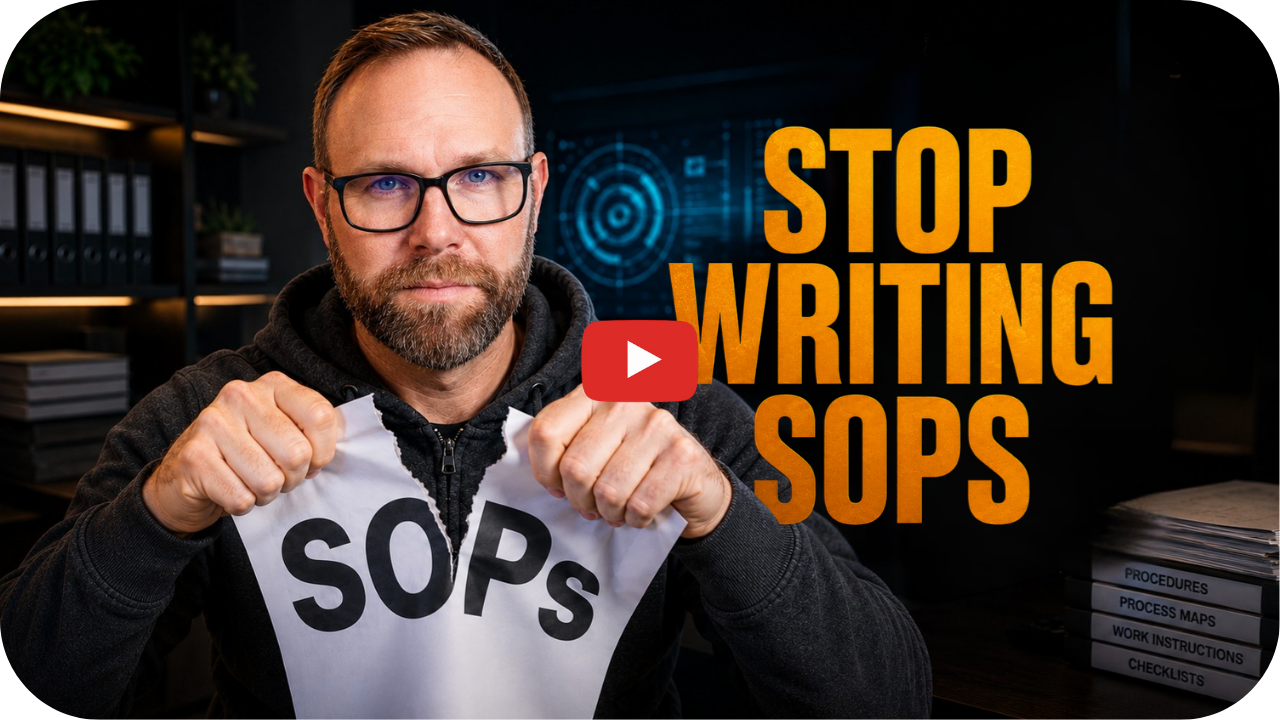
Most documentation projects produce the same outcome. You run the sprint, you fill the folder, and six months later the team is still asking the founder the same questions. The folder got bigger. Nothing changed.
The reason is almost always the same. The work was treated as a documentation problem when it was actually an ownership problem.
What AI has changed
AI has removed most of the friction from writing SOPs. Record yourself doing a task, drop the transcript into an AI tool, and you have a usable process in under five minutes. That is genuinely useful. It has also made something very clear: writing processes was never the hard part. The hard part was always getting someone to own one, maintain it, and actually use it.
AI can write the document. It cannot decide who is accountable for it. That decision belongs to the founder.
What happens without ownership
When nobody is named as the person accountable for a process, the documentation sits in a folder. The team still asks the founder the same questions. Nothing changes except the folder got bigger.
The documentation is not the asset. The ownership is the asset.
The two-week leave test
There is a simple test to know whether a process is truly owned. If the person responsible goes on leave for two weeks, what happens? Not to them. To the process. Does it keep running? Is there a trained backup? If the answer is no, you do not have a process owner. You have a person who does a thing.
Playbooks, not micro-SOPs
A micro SOP tries to document every single step and every single task. It sounds thorough. In practice it becomes a maintenance problem. Processes change, tools change, and the micro SOP is already out of date before anyone has read it. Nobody wants to own a document they have to rewrite every time something shifts.
A playbook is different. It documents the intent, the standard, the trigger, and the outcome. It gives enough for someone to execute well and make smart decisions without trying to anticipate every edge case. That kind of document is easy to own, easy to maintain, and it will actually get used.
The order that actually works
Start with an ownership map, not a documentation sprint. Sit down with your team and assign every core function in the business to one person. Not a team. One person, one name.
Once ownership is clear, the documentation follows naturally. The person writing the SOP is the person who will live with it. They use AI to do the writing, keep it playbook style, and because they own it, they actually keep it current.
Once you have a clean, owned, playbook-style knowledge base, you can put an AI on top of it. Any team member can ask who owns the client onboarding process, what the standard is for handling a refund, what to do when the owner is away. The AI reads the knowledge base and answers accurately. Documentation becomes a live operational tool, not an archive.
Where to start
Start with one question: who owns what? List every core function in your business. Assign one name to each one. Do not leave anything unassigned. Do not let yourself be the default answer.
That map will cost you an hour. It will show you exactly where your business depends on you and where it should not.
Start here: virtualdoo.com/products