Most founders add before they audit. A new hire lands on top of the old structure. A new tool sits alongside tools nobody uses. A new process competes with processes nobody owns. This episode is about running the audit first.
What Inherited Complexity Actually Looks Like
It does not feel like a problem. That is what makes it hard to see.
Roles exist because someone built around them. Meetings run because they have always run. Tools stay because nobody has stopped to ask who owns them. Nobody chose to keep any of it. Nobody decided to stop it.
That is inherited complexity. And it compounds every time you add something new on top of it.
Every new hire has to navigate the old layer. Every new tool has to sit alongside the tools nobody uses. Every new process competes for attention with processes nobody owns.
An SEO Agency That Got Faster by Deleting First
Twelve people. Three years of steady growth. By the time I walked in, a significant part of the team’s time was going into coordination work, not the output the business was built to produce.
We did not start by building anything. We started by deleting.
In the first four weeks: roles removed that were managing processes that should not have existed. Tools cut with no clear owner and no clear output. Recurring meetings cancelled that produced nothing actionable.
The team did not get smaller. They got faster.
That is the carrying cost. Not just what you spend to keep those things running. The compounding cost of building everything new on top of them.
The Two-Question Test
Before you add anything to your business, run this test.
For any role, process, tool, or recurring meeting, ask two questions.
Who owns this? One name. Not a team. One person accountable for its output. If you cannot name one person, that is a flag.
What does it produce in one sentence? A role produces an outcome. A process produces a result. A meeting produces a decision or an action. A tool produces something the team cannot do without. If you cannot write the output in one sentence, that is a flag.
One flag is a warning. Two flags means delete it before you build anything else on top of it.
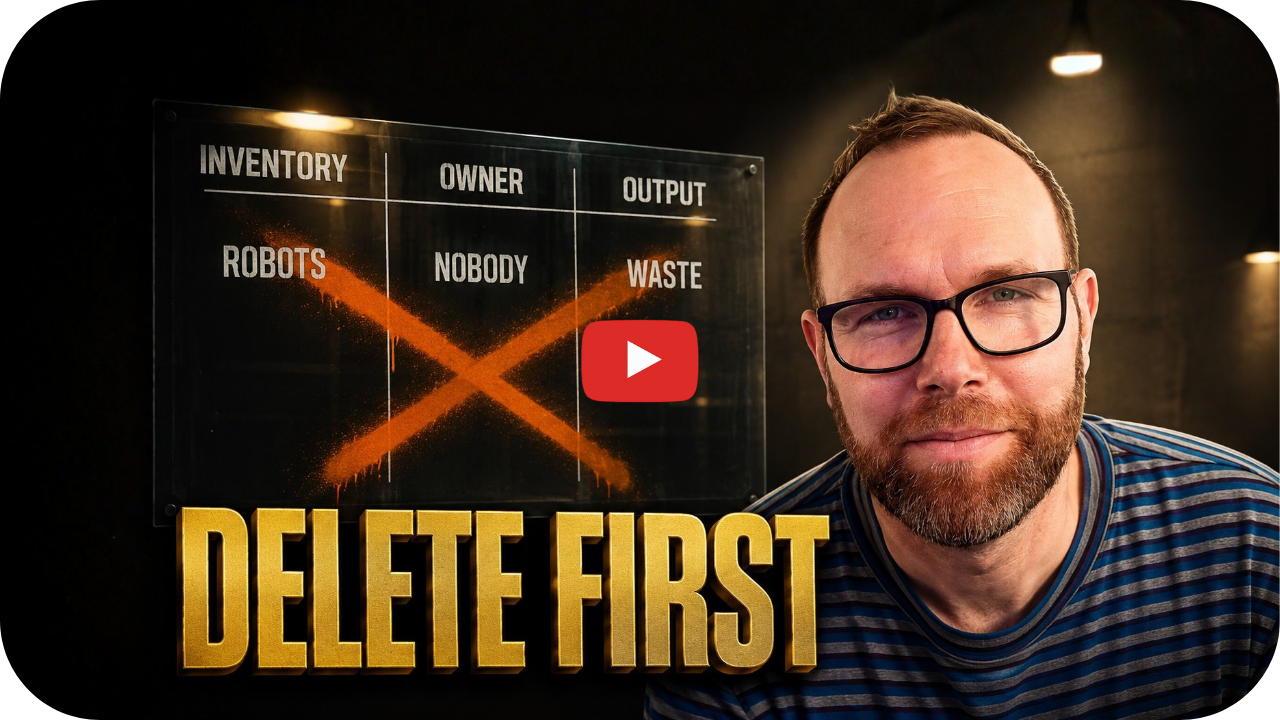
The Three-Column Exercise
This takes about an hour.
Column one is the inventory. List everything the business is currently running. Every role, every recurring process, every tool the team pays for or uses regularly, every recurring meeting. Do not edit it. Get it all down.
Column two is the owner. For each item in column one, write one name. The person accountable for its output. Not a team. One name. If you cannot write a name, leave it blank. Anything blank is a candidate for deletion or reassignment before you do anything else.
Column three is the output. For each item, write what it produces in one sentence. Not what the role does or what the process involves. What it produces that the business needs. If you cannot write it in one sentence, leave it blank.
At the end, you have a full inventory of everything the business is carrying with a flag next to anything that has no owner and no clear output. Those flags are what you delete before you build anything new.
Where to Start
You do not need to run this across the whole business in one sitting. Start with the area that feels the heaviest. The part where the team is busy and the output is unclear.
Run three columns there first. What you find will tell you where to go next.
Elon Musk had orange spray paint. You need a spreadsheet and an honest hour.
Start here: virtualdoo.com/products