The 247 SOP Problem
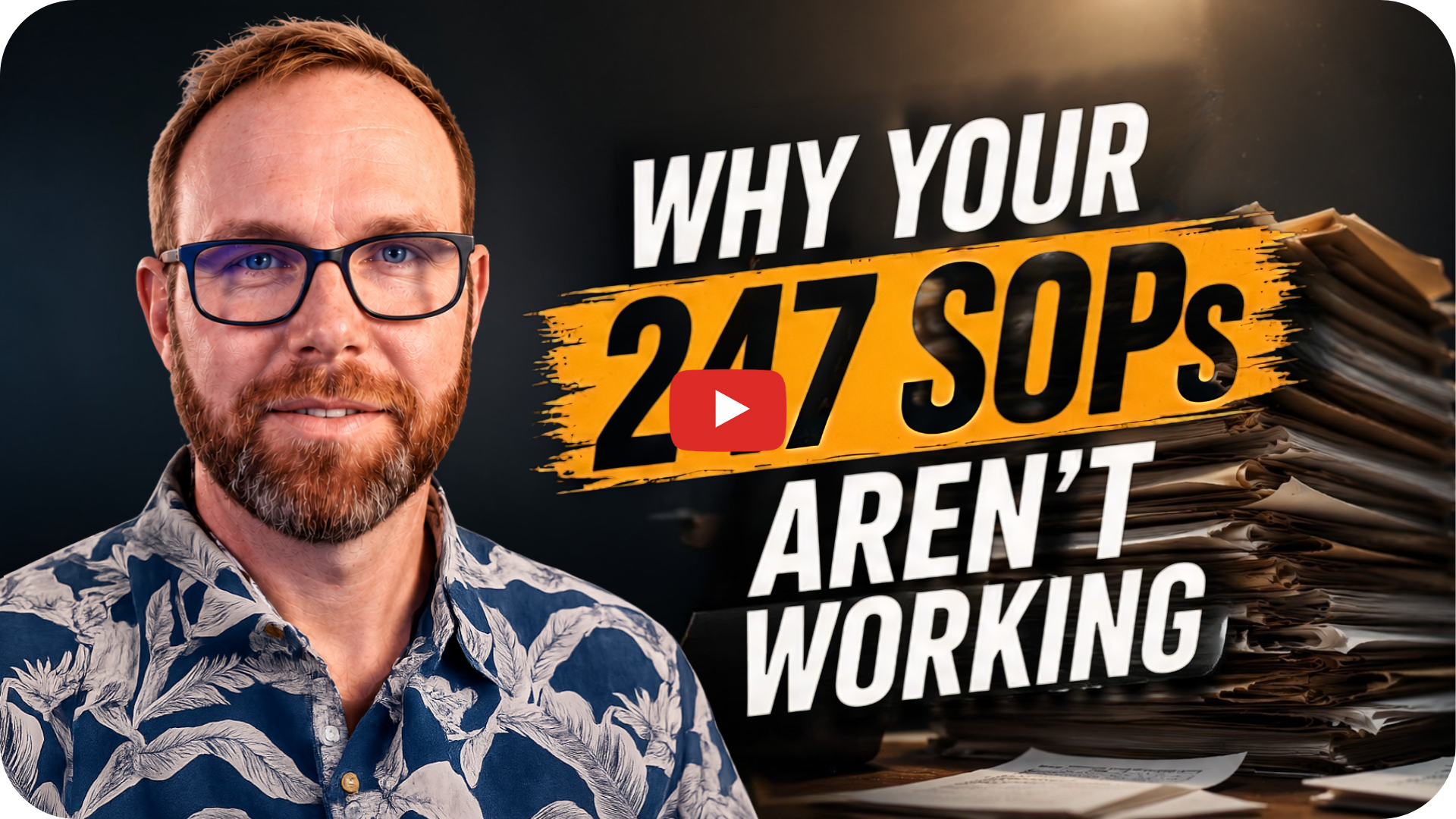
I worked with a founder who handed me a Notion database with 247 standard operating procedures. He had spent six months building it, hired a process manager, paid for a consultant, and run a documentation sprint with the team.
Eight weeks before I arrived, the team had stopped using it. Every exception was still ending up on his plate.
The SOPs weren’t bad. They were answering the wrong question.
Why Systemising Everything Still Leaves the Founder Stuck
There’s a school of thought that says the way to scale is to document every process and train the team to follow the library. It’s a real strategy and it works for some businesses. It also produces a very particular kind of stuck. The kind where the SOPs are good and the founder is still the bottleneck.
That’s the founder I get called in to help.
Here’s what I usually find when I open the library. The processes are documented and the decisions are not. The team knows how to do the work. They don’t know what to do when the work hits an exception, or who has the authority to call it, or what the founder’s preference is on a judgment call.
So every exception flows back to the founder, along with every judgment call and every variation from the standard process.
A library tells the team how we do it. The team also needs to know who decides when we don’t.
A Library and A Map
A documented process tells your team how to do something. A decision map tells your team who owns the call when something changes.
Operations failures often sit in the routing of decisions rather than the writing of processes. The team doesn’t know who owns the call, so the call routes to the founder by default. You can have a perfect library and still be the bottleneck if your decision map doesn’t exist.
One Step Earlier
David Jenyns talks about a related move. He says to find your critical client flow, find the bottleneck inside it, and only document around the bottleneck.
I agree with the focus. I would push it one step earlier. Before you decide what to document, decide who owns each decision in the flow. Map the flow on one page. Mark every point where a decision happens. Then mark who owns it.
If every decision marker has your name on it, you’re looking at an authority problem. Documenting the process won’t move it. The team will keep coming to you.
What This Looks Like When It Works
Brendan Elias ran his business as a client of mine for two years. His team had documentation. What he had on top was a clear decision map.
For every recurring exception, every judgment call, every variation, somebody other than Brendan owned the call. His team owned the decisions all the way through. They made the call, ran with it, and dealt with the consequence.
That’s why the team’s rhythm held when Brendan was out for two weeks. The decisions kept getting made by the people who owned them.
The Move This Week
Don’t open Notion. Don’t write another SOP.
Take a sheet of paper or a whiteboard or a single Loom recording and walk through your most important client flow from inquiry to delivery.
Mark every point where a decision gets made. Pricing exception, scope adjustment, escalation, refund, timeline change, hiring need, vendor selection, anything.
Then ask, for each decision marker, who owns it.
If the answer is you, ask the second question. Does it have to be me?
If it doesn’t have to be you, that decision is the next thing to transfer rather than the next thing to document.
Transfer comes before documentation. The SOP gets written for the person who owns the decision once the decision has a name on it.
The Work Underneath the Work
The reason I lead with the map is because the map shows you what’s actually broken.
A team without a procedure can usually figure out the work. A team without a decision map cannot stop routing exceptions back to the founder. A missing procedure is an afternoon’s work. A missing decision map is the structural work underneath the procedures.
What It Looks Like Once You’ve Got It
The team has a one-page map of the client flow. Every decision has a name on it. Whoever’s name is on it owns the call. Your name only appears on the decisions that genuinely require you.
The team handles exceptions inside their authority. The team escalates the things that genuinely need escalating, on a cadence, not in real time. The founder gets seven decisions a week, not seventy.
That’s the difference between a business that runs without you and a business that has good SOPs and still runs through you.
The SOP library is the artefact. The decision map is the leverage.
The First Question
If you’re sitting on a Notion database with 247 procedures and the team is still coming to you, the move this week sits upstream of writing another SOP. Take a piece of paper, sketch the flow, and put a name on every decision.
Once you have that, the SOPs you actually need become obvious, and the ones you’ve already written that nobody uses become obvious.
A map shows you what to keep, what to write, and what to delete.
What’s the first decision in your business that has your name on it that shouldn’t?
If you can see this pattern in your own operations, the Operations X-Ray maps where decisions are routing in your business and what’s keeping them on your desk. Start here: virtualdoo.com/products