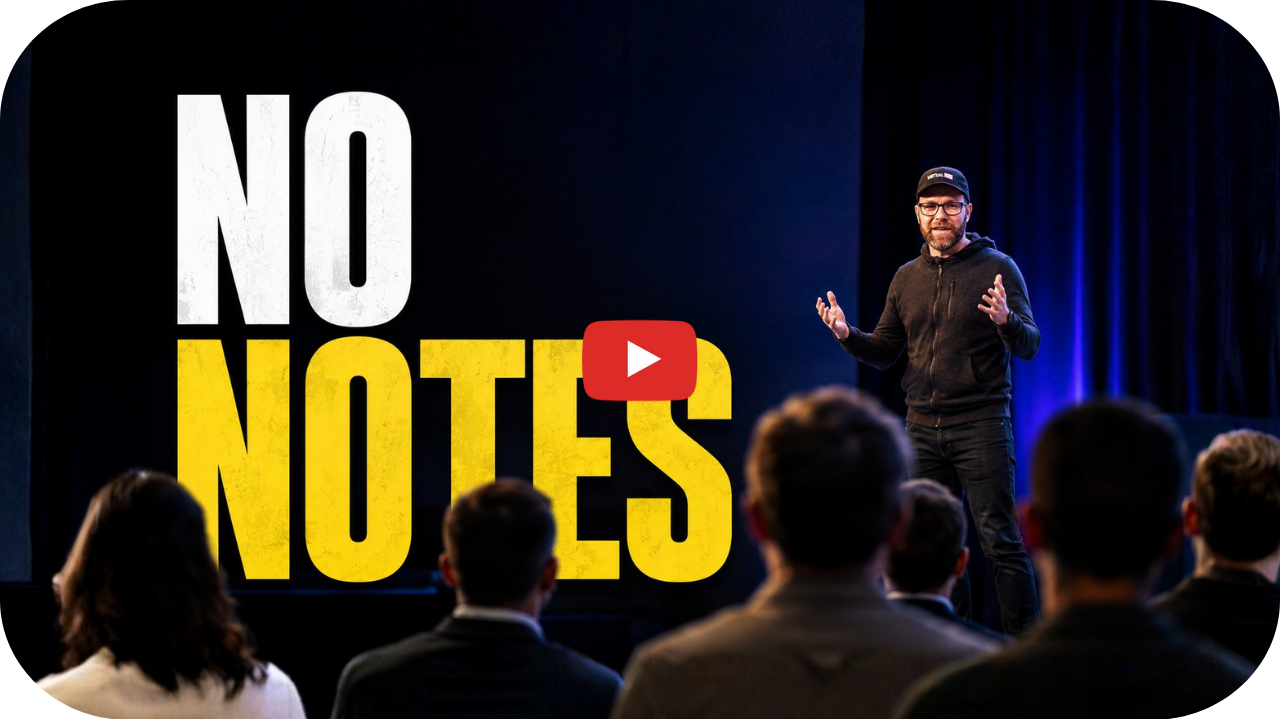
There is a stage coming, or a room full of people, and at some point as a business owner you are the one who has to stand up and speak. That is how your business gets known. Here are the five steps I use every single time, and what happened when the power went out in front of 200 people.
Write the script, even when it is rough
Most people get stuck here because they want the first version to be perfect, and perfect is what stops them finishing. Get it all out first. Forget slides, graphics and order. Just write what you actually want to say. The first draft is not the speech, it is the starting point. Mine was better on the tenth run than it ever was on the page.
Learn the points, not the words
In front of a big room you cannot read off your phone or stare at a slide. You have to know the material well enough to be interrupted and carry on.
In Fiji the screen went black and the power went out twice, in front of more than 200 people. It did not matter, because I did not know the script, I knew the points. I found my place and carried on.
The Roman Room
You picture a place you know well. For me that is my apartment, the same walk in the same order every time. Then you break the speech into pictures and put one in each spot.
For a short talk about happiness, the first point was to raise a glass and celebrate small things, so I put a champagne glass on my stairs. The next point came from a professor’s study, so I put a professor in the foyer, with a giant three million next to her for the number of people who had taken her course. The study found money does not make us happier, so in the lift I pictured money and houses falling through the floor.
Three points, three pictures, each in a room I walk past every day. I now put the written speech into AI, which already knows my rooms, and ask it to generate a picture for each one.
Do the reps
Omar Zenhom, who hosts The $100 MBA Show, practices a big talk 27 times. He knows it well enough that you could stop him anywhere and he would pick it straight back up.
Think about your favourite song. You know every word, not because you sat down to memorise it, but because you have heard it a hundred times. A speech works the same way.
Will Wang, who built and sold a marketing agency and MCs at big marketing events, never takes new material straight to a big stage. He tests it somewhere small first. Comedians do the same thing in small clubs before the big show. For me that place is Toastmasters, and every run there gave me feedback on the humour, the structure, and once on a word that meant something completely different to how I was using it.
Get feedback when you have no audience
Put your written speech into AI. Then record yourself giving the talk. I open the voice recorder on my phone and go for a walk on the beach with my dog, talking the whole way through with my hands going. Most phones will then give you a transcript. Put that back into AI and ask it to score you. It tells you what worked, what you missed, and where to improve.
Walk the space
I picked this one up from Jared Codling. If you are speaking somewhere new, go and stand there first. The day before Fiji I got up on the empty stage, walked the edges, and stood where I would be standing. By the time it was full it did not feel new.
You do not have to be a natural
I am not. Speaking well in front of a room comes down to how you prepare. Write the script even if it is rough. Build the scaffold so you know the points, not the words. Do the reps. Get the feedback even with no audience. Walk the space before it counts.
Start here: virtualdoo.com/products